Showing posts with label empathy. Show all posts

12 April, 2011

Author turned psycho-killer!

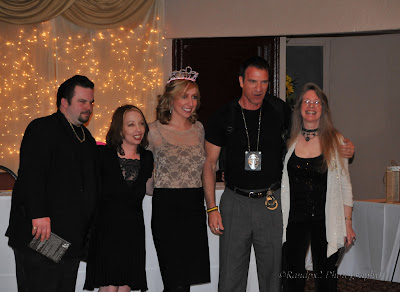
Saturday evening, April 9th, I attended an event billed as “The Manchester Arts Association Murder Mystery Dinner With a Twist.”

SOME twist!!

Cast from left to right: John Gorham, Jaki Valensi-Lauper, Angela Campion, Michael Moss, Pamela Glasner

I played a psycho-killing lunatic who, in the process of trying to murder Angela (the lady in the tiara) and in the space of 90 minutes, poisoned one woman, shot one man and then stabbed another — killing everyone but my intended target. Then — icing on the cake — topped off this genteel evening with a cat-fight (with Angela) in the center of a posh restaurant’s dance floor.

Fortunately for the rest of the world, I harbor no secret desire to be an actor. Missed a few cues and messed up a few lines — BUT — I had a GREAT time!

Nothing like a little psychopathic murdering spree to help you unwind at the end of a busy week.

02 April, 2011

Soprano Christine Reber


Christine Reber, the amazingly talented soprano whom Deborah Louise Robinson and I met when she performed at Couture Fashion Week at The Waldorf Astoria in NYC last month, sent me this photo of the three of us. She is such a sweet woman with an even sweeter voice. It’s been a pleasure getting to know her!

08 September, 2010

Interview With Para Explorers Radio


Sandra and Russ Wells of Para Explorers Radio focus on paranormal & historical research.


On September 7th 2010 they spoke with Ms. Glasner about her writing in general, “Finding Emmausin particular, her research methods, her commitment to historical and factual accuracy, and her characters’ roles as social advocates.

http://www.blogtalkradio.com/para-explorers-radio/2010/09/08/pamela-glasner--author--finding-emmaus

05 November, 2009

Finding Emmaus - an inspiring saga of which Michael Crichton would have been proud


“Finding Emmaus”
By Pamela S.K. Glasner
ISBN: 978-1-934572-33-7

Review by Christopher Belton
Reviewer and Author of more than 40 fiction and non-fiction books

The promotional blurb for
Finding Emmaus touts it as being a ‘dark fantasy,’ but this, in my opinion, does it a disservice, for it is much, much more. It is an inspiring saga of history, adventure, religion, politics, suspense, mystery and romance, all neatly wrapped up in a compelling conspiracy of which Michael Crichton would have been proud to have conceived. Admittedly, the plotline does touch upon certain aspects that could be considered paranormal in substance, but the overall effect of the book does not leave the reader with an aftertaste of ‘fantasy,’ but rather of having been introduced to a disturbing reality that will generate a slight sense of inadequacy for not having been aware of the problem before.

Finding Emmaus is a story about empaths; people who are naturally gifted—or cursed—with the ability to feel the emotions of others as acutely as if they were experiencing them themselves. Although encased within a single volume, the reader is in fact treated to two separate tales that evolve three and a half centuries apart, but which are intricately woven together with a common thread that is empathy. The plot examines the lives of two people—Francis (Frank) Nettleton and Katherine Spencer—who have both been troubled since birth by the gift/curse of empathy, albeit in different ways. Frank is a product of the seventeenth century, during which any form of eccentricity was diagnosed as madness or devil-worship and dealt with severely. Katherine, on the other hand, is a product of the more enlightened twentieth century, yet the lack of any clinical method to diagnose empathy has resulted in her being treated as a manic depressive and poisoned with expensive drugs that have no hope of providing her with solace or a cure. The tragedy of the empaths induces Frank to do something about it, and in order to complete his life’s work, he reaches across the centuries and recruits Katherine to his cause.

Ms. Glasner is an exceedingly capable writer who has managed to consistently incorporate two distinct styles of writing within the same book; a feat that would be beyond the reach of most authors. Frank’s story is written in the first person, and when this is put together with Katherine’s story, which is written in the third person, the reader is left with the impression that the book has been co-authored by Ms. Glasner and Frank himself. The historical atmosphere of the early settler days of Connecticut rings especially true, and the warmth that the prose exudes speaks volumes about the author’s love of her subject.

One point that I found particularly impressive—and of which I write with envy—is the way in which the book starts.
Ms. Glasner has attained the Holy Grail of fiction by writing an opening that is so compelling that I defy anybody to read it and then put the book aside; as follows:
The year is 2008. I am, as I have been for the past two
hundred and fifty-one years, ninety-eight years old.

If pressed to criticize the book, I would have to say that I was a tad disappointed that the conspiracy concerning pharmaceutical companies was not developed further as the book drew to a conclusion, but if I were to be honest with myself, I would probably put this down to the fact that I just didn’t want the book to end. It was a great read and I thoroughly enjoyed it.

Finding Emmaus is Ms. Glasner’s first novel, yet it contains all of the elements that could be expected of a much more experienced author. I am sure that I will not be the sole reader who is deeply thankful that it represents only the first book in the Lodestarre Series.

And, of course, please don’t forget to visit my website to read the previews of Finding Emmaus, book one of The Lodestarre Series.

Copyright © 2009, All Rights Reserved

31 August, 2009

The Arrival of Mia Rose


May I present my granddaughter, Mia Rose, just an hour old - my future little empath!

28 July, 2009

Finding Emmaus - The Video

Twice in this month, I had the pleasure of speaking with Tony Serve of Perth, Australia, a presenter at Radio 6pr (6pr.com). I am awed by Tony’s commitment to the rights and dignity of all those who have been (and are still being) victimized by drug companies - a multinational industry which callously pumps tons of toxic waste into millions of unsuspecting citizens.

Unfortunately, the inappropriately drugged “mentally ill” are not the only victims in this ongoing conflict. For every person who is being misdiagnosed and over-medicated, there are parents and husbands and wives who love them and children who desperately need them, there are sisters and brothers who miss them, there are bosses and co-workers who must deal with lost productivity, there are mounting debts that ordinary citizens wind up paying through increased insurance rates or increased taxes or increased medical charges. One way or another, everybody loses - except the pharmaceutical industry.

In an economic environment where layoffs and firings and downsizings and closings have become the norm, this one industry - with its billion-dollar budget to spread around Washington DC - has increased its bottom line from $12 billion $69 billion in four short years!


The following video is the result of those two conversations I had with Tony:

http://tinyurl.com/mhuyfw


Copyright © 2009 by Pamela S. K. Glasner, All Rights Reserved

The Inalienable Human Right: The Right to BE

Katherine Spencer, Empath, on Patients’ Rights
(an excerpt from Finding Emmaus)

“Maybe, just maybe, it’s time to err in favor of patients’ rights a bit. I don’t know how much you know about the history of mental patient care, but most of what I’ve learned and all of what I’ve experienced would be enough to keep Hollywood up to their ears in horror films for a decade.

“Second only to the very young and the very old, there’s no easier target for abuse than the mentally ill. They have very few defenses and fewer advocates. Many times, particularly when they’re medicated, they have no way to express what’s happening to them, so they can’t even say something as simple as ‘Doctor, I’m having terrible side effects’ or ‘this isn’t working for me’.


Are you aware that as recently as twenty-eight ago, twenty-seven states in this country - our country! - were actively forcing surgical sterilization on Americans who were diagnosed as mentally ill?

And keep in mind: there’s no definitive test for mental illnesses like bipolar disorder. It’s all your doctor’s best guess based on the information available and accepted medical norms at the time. So, what if they were wrong? How many people were sterilized ‘accidentally’?

“Worse than that, a few of the governors of those states, though they have apologized, claim there’s no need to even consider compensation because the victims are mostly dead and, of course, there wouldn’t be any offspring to compensate! They actually said that - using the tragic results of their abuse as a means to evade responsibility. It’s despicable.

“The pendulum will probably swing way too far to this side for a while, but maybe that’s what’s needed - not to endanger anyone - even one more lost life would be a tragedy - but it’s got to stop.”


Copyright © 2009 by Pamela S. K. Glasner, All Rights Reserved


05 June, 2009

Finding Emmāus - The Very Human Need To Fit

I’m not sure just how much of children copying the styles of other children is peer pressure (something which is external) or how much of it stems from the innate human need for community (something which I see as internal). I think humans have universal needs - needs which would not be “universal” if they originated from an external source. Among those are the need for acceptance and community.

Humans are not solitary beings. We’re not like bumble bees. We’re social creatures, preferring the herd. Are there exceptions? Of course. Some of us live out our lives in seclusion, others want the comfort of knowing friends and family are near but still require “alone time” on a regular basis.

But in general, most of us want to feel as though we are a part of something bigger than ourselves: a family, a place of worship, a social network, a neighborhood…

So, back to my earlier statement about children mimicking the behavior of other children. I’m not all that convinced it’s a learned response. I think it’s more likely an internal - and very primal - need for attention, for security, for love. The youngest of infants have those needs. No way that’s born of societal pressure.

Children learn very quickly that the road to attention, security and love is paved with approval, beginning with Mom and never truly ending.

If I buy a dress like yours or move into the same neighborhood as you or start listening to the same music you listen to or start following the same sporting events you follow, I have just made a public declaration that what you have or what you are or what you like or what you do is worthy of imitation - the sincerest form of flattery, right? And if you, in return, give me the approval (aka love) I crave, then I have just become a part of something outside of me, a part of you, a part of a community and I am therefore no longer alone.

Conversely, without that, there’s a huge hole in me - sometimes big enough to drive a truck through.

If I’m different - if I’m an Empath or if I’m bipolar or if I’m a witch- then I don’t get to have that acceptance, that feeling of belonging, that security, because people will go out of their way to avoid me. I will become isolated. People shun me because they’re afraid or they don’t understand or they just don’t know how to handle my “different-ness”, my uniqueness.

When you get right down to it, no-one really wants other people to be that different from themselves. I think people would prefer that others fall in line with what they consider to be the norm because that’s their comfort level.

This is the foundation of “Finding Emmāus”: two Empaths in two different centuries dedicating their lives to the celebration of those differences and to putting an end to the isolation.


Copyright © 2009, All Rights Reserved

28 May, 2009

"Finding Emmāus" goes live!

I truly enjoyed Tuesday night's interview with Cori Brackett at www.SweetRemedyRadio.com

I was quite nervous in the beginning because it was my first live interview, but Cori is such a splendid host, she put me at ease very quickly.

We discuss several different aspects of the story: empathy, early Puritan history, psychotherapeutic drugs, the collusion between the pharma industry and the FDA, advocating for those who've been ostracized from society, what it was like for me to write the book.

I'd be honored if you'd take the time to listen. It's located at: http://tinyurl.com/p3xjlw

I hope you'll find it interesting.

03 May, 2009

The Dreaded Synopsis!

After stringing 170,000 words together into a coherent document and calling it a novel which, believe me, was no easy task, I found myself in the unenviable position of having to create - OH NO!!!! - The Dreaded Synopsis!

Of course, I’m no expert. I can only speak from my own experience. But I’d be willing to bet that if you ask any author who’s ever had to write one, particularly their first one, the reactions you get will all be pretty similar: something akin to a shudder.

But I think I figured it out. At least, I figured out what worked for me. So I thought I’d share it.

After struggling with it for what felt like ages, it turned out that the best way to tackle it was to shorten it to just one sentence and work from there. Believe it or not. I’ll tell you how it came about:

My agent had instructed me to come up with an elevator pitch - a one-sentence, 20 or 30 second description of my book. I freaked out! 750 pages boiled down to one sentence? I thought, you’re nuts!

Of course, I didn’t say that - I just said, “Yes, Yoda, you teach, I will follow”

I was going to a premiere screening of a friend’s movie at a film festival and media types were expected to be there and Pamela (my agent is also Pamela - makes for very interesting conference calls) told me I needed to be able to pitch the book to them for future interviews - and I’d only have 20 seconds to do so.

So I agonized and scribbled and typed and edited and swore (Tsk, Tsk - New York City girl that I am!) and typed some more but eventually - in about 2 days - came up with one perfect sentence. From there the rest was a piece of cake.

What I learned from that exercise is that it’s so much easier to start with something tiny and expand on it, then to start with something huge (like my outrageously long novel) and shrink it.

Once I had the one sentence, Pamela said, “OK, now you need a 100 word synopsis. You’ll need that for newspaper announcements as we get closer to the launch date.”

That only took about an hour to write and perfect, though I admit I tweaked it a few times over the next few days.

Then she said, “OK, now you’ll need one with 200 words, 500 words and 750 words - to send to the media when they want to interview you, to post on your website, to start requesting endorsements, and so on.”

Which was fine with me because once I had the 100 words, the rest came VERY easily.


Copyright © 2009, All Rights Reserved

27 April, 2009

What "Finding Emmaus" Is All About

“Finding Emmaus”, book one of The Lodestarre series, is a complex, dark historic fantasy about love and loss, obsession and the abuse of power, human frailties and a determination to live a life that matters.

The psychiatric community has confused Empathic personality traits with mental illness with tragic results, leading two Empaths, living three hundred years apart, on personal journeys to learn the true nature of Empathy. Transcending time and death to right a centuries-old wrong, they inadvertently uncover a multi-billion dollar conspiracy in which millions of Americans are being misdiagnosed and drugged for no other reason than the enormous income they generate.

Francis Nettleton, 17th century Empath, grew into adulthood believing himself to be insane. Eminently moral but the product of a society steeped in myths and misconceptions, he makes some less-than-prudent decisions which set in motion a murder for which he cannot forgive himself, a murder which will reverberate through four families and three centuries.

Three hundred years later, enter Katherine Spencer. After years of being hospitalized and drugged, she is given a rare opportunity: a second chance at life. At fifty-four, after being told that, rather than being insane, she’s more than likely Empathic, she sets out to find Francis and the legendary Lodestarre, both 300 years gone, in the hopes she can finally learn to live.

In the process of finding herself and mastering her newly-discovered abilities, Katherine unwittingly becomes the champion for the voiceless millions who are being victimized by a corporate machine of such omnipotent political power that she literally puts her life on the line when she challenges the all-but-unstoppable pharmaceutical industry, America’s most powerful and affluent lobby.

Then, into Katherine’s life comes Sally Cavanaugh, powerful - though novice - Empath with a secret infatuation which eventually transforms into a full-blown obsession. Overshadowing her ability to discern right from wrong, this obsession just might jeopardize every good thing in her life and everyone else’s - just to get what she wants.

In Wiccan tradition, there is the Book of Shadows; in Christianity, the Bible; even the secular world has its encyclopedias. But for Empaths, there was nothing of the sort until Francis Nettleton sacrificed everything and made it his life’s mission to create one authoritative body of knowledge, one central set of guiding principles - and he named it The Lodestarre. This manuscript is nothing less than the lifelong, selfless passion of one man’s profound desire to put an end to the relentless persecution and needless suffering of anyone who did not - or could not - fit the societal mold.

“Finding Emmaus” is an intricate, meticulously-researched, deeply disturbing, suspenseful tale of love and sacrifice, brutality and greed, courage and politics and madness and faith. It is a story with a huge cast of characters who will keep you guessing what will happen, what they will do and what choices they will make from one minute to the next as they weave in and out of the story and each others’ lives.


Copyright © 2009, All Rights Reserved

14 April, 2009

Seeing Is Part Of Believing - Musings of an Author

One of the things I went out of my way to avoid while I was writing "Finding Emmaus" was physical descriptions of my characters. With few exceptions, I kept them very superficial:
- Frank is tall and, at 60-something years old, has grey hair
- Hannah Moreland is petite and hyperactive, much like an arachnid
- Alice Bond is tall and stately, very slender, moving through her home and her life like a wraith
- Katherine is short with long hair and Sally has a figure to die for

But that’s about as detailed as I got in most cases and that was deliberate.

As readers become more and more involved in a book, I think they ‘see’ what’s going on inside their heads and, as part of that, ‘see’ images of the people who play out the story, and imagine the people in a way that makes the story more meaningful to them.

My feeling was that I would detract from that individual, highly personal experience if I superimposed some arbitrary physical description of a character which might be contrary to what the reader needed to see in order to believe in it.

And that would benefit neither the reader nor the writer - and do the story itself a great injustice.

11 April, 2009

New Family Member Introduces Herself

OK - so this is nothing about the book, but it's exciting news nevertheless and needs to be announced:

My son and daughter-in-law called me yesterday afternoon to tell me that they just had their latest sonogram and the baby is girl! Her name is going to be Mia Rose. What a trip!

Maybe she'll be fascinated by Empaths and want to write a book about all things Empathic, just like her Grandma .....

I'm beside myself with excitement. I never had a little girl so I never got to buy all those sweet dresses and hair bows and all the things I wanted to buy. And, of course, now I'm Grandma, so it's my moral obligation to buy all that stuff and spoil her ROTTEN, right???

Of course, if she's anything at all like me, she'll be a tomboy (just like I was) and be so busy beating up all the boys and playing football and wading into the pond to catch frogs and proving she's not afraid to jump off the roof of the garage that I'll never get to buy any of those adorable little dresses!

Have a blessed Easter everyone!

06 April, 2009

Update from the publisher - I guess they like Empaths, too!

Finding Emmaus is a dark historic fantasy, two concurrent stories, one set in the 17th century and the other in the 21st - a story about Empaths and ghosts, ignorance, victimization and obsession, a story in which each of the two principle characters, Frank in the 1600’s and Katherine in present day, has a quest which neither can complete on their own.

Tomorrow I have the conference call with the publisher and, in advance of that, my contact person there sent me the production plan and the pre-production comments. I wanted to share with you what the editorial staff wrote in their report about my book:
'The Lodestarre' is a richly described historical fantasy that weaves elements of the fantastic with actual facts and figures. Alternating viewpoints in different eras maintain a strong pace for the story, reveal intimate truths about Frank and Katherine, and strengthen their intertwined tales. The text is engaging and well-written with few errors.

Talk about feeling gratitude! I've written a novel that a group of professionals call 'rich', 'strong', 'engaging 'and 'well-written'. A first-time author, the only agent I ever approached, the only publisher we submitted to and now this. If that’s not God at work, I cannot imagine what is.

05 April, 2009

From "The Lodestarre": Katherine's Musings on Faith and Being Empathic

Being an Empath is not easy. Some call it a gift, some call it a curse. Whichever it is, Empaths have two choices: hide away and suffer through it the best you can until death finally brings relief, or learn to live with it - and live.

And I believe that starts with faith. But faith can be a tricky thing.

Some people use ‘faith’ as a weapon, something with which to punish themselves, thinking (wrongly) if it’s not strong enough or consistent enough or blind enough then they must be doing it wrong. And if they don’t get a particular result they want, that self-flagellation suddenly seems justified (You see? Had I done it better…).

But I don’t believe that’s the way it works. I don’t believe God is some vindictive son-of-a-$#@%$ sitting up there on a cloud just waiting for me to screw up so he can deny me my heart’s desire.

I struggled with the question of faith for a long time. Oh, I've no doubt that God exists, that He’s all around me, that I’m His daughter and therefore He loves me, that He listens to me with infinite patience, even when I ask the same things over and over again (and does not roll His eyes no matter how many times I come back for reassurance!). I believe He wants me to have my heart’s desire and I know He answers my prayers with astounding regularity.

But none of that ever interfered with my ability to riddle myself with doubts and then beat myself up because surely faith requires the absence of doubt, does it not?? (the answer is, ‘Of course not!’)

I've never prayed for my Empathic abilities to go away, although I suppose others have, and I can understand why. It’s a hard thing we live with. But I think ‘understanding’ changes everything.

Empathy will never be something we carry lightly. We will still feel the pain. But with understanding - and faith - we can step out of the dark.

Copyright © 2008 by Pamela S. K. Glasner, All Rights Reserved

03 April, 2009

From "The Lodestarre": Katherine's Musings on What It Is Like To Be An Untrained Empath

Empathy is based 100% on feelings, sometimes physical, but primarily emotional. There are no words or pictures, no past or future; it's all about feelings and sensations, and time has no relevance. An Empath can be psychic or telepathic, but those are completely separate phenomena.

Empathic events involve other people's feelings, not the Empath’s, but an untrained Empath has no way to know this. An untrained Empath does not have the necessary tools to distinguish between their own feelings and the sensory output of others.

The biggest problem for the uneducated Empath is it’s hard to identify.

No-one is supposed to hear voices or see hallucinations, but everyone is supposed to have feelings, so there's nothing concrete to describe as being unusual or out of the ordinary, which is why it's so hard to differentiate between being an Empath and not. What would the Empath say? ‘I’m having a feeling” ??

But just try to imagine what it must be like; imagine experiencing other people's feelings. And, of course, it would only be the most powerful ones. Being glad you're about to eat a tuna sandwich at your favorite restaurant might make you glad, but is not likely to elicit a whole lot of passion.

So - pretend you are an Empath but you don’t know it, and pretend you are walking down the street. As you walk, you cross paths with of a very angry man. Empathic events are not always about proximity, but we’ll use proximity for this example. You’re walking along and you’re feeling fine and then suddenly, for not reason, for just those few moments as you and the angry man pass each other, you feel absolutely furious. The anger comes on like a tidal wave.

Then the man is gone and it's over. And your anger slowly fades. And you’re slowly starting to feel like yourself again, except that now you approach a woman who is desperately sad. And as she passes, your mood swings from fading fury to intense grief. Suddenly all you want to do is double over and sob, but in reality, there's nothing for you to cry about. Then she's gone and just as equilibrium is starting to return, along comes a man who just got the job of his dreams and he's ecstatic - and before you’ve really had a chance to recover from the rage and the tears, your ragged emotions slingshot abruptly from anguish to euphoria.

Can you imagine what it must be like? How confusing and frightening?

Now try doing that in the mall at Christmas time…

Or at Chicago O’Hare Airport in the midst of a sudden snow squall…


Copyright © 2008 by Pamela S. K. Glasner, All Rights Reserved

Continuing the Creation of a Dark Historic Fantasy About Empaths

From “Finding Emmaus”:
Empath Katherine Shares Her Feelings About Being Empathic

I'm experiencing that same feeling I get when something bad is about to happen. No, that's wrong. I’m not Prescient, I’m Empathic, which means it's the same feeling I get when something IS happening or HAS happened and someone is reacting to it and I, in turn, am reacting to them. It's almost as though I can sense some shift in the universe, some energy that's emitted, even as the event occurs.

Concurrent with that is the knowledge that I cannot prevent it or in any way assist the person it's happening to because I'm in the dark: I've no idea what it is or to whom it's happening.

But what if I did? What then? Would Paul have listened last year if I’d told him his partner was having a heart attack? Would Michael's wife have believed me, or thanked me, for telling her he was being murdered across town as we sat there in the laundromat? Could I have done anything to prepare Toni's family for the pain headed their way? Of course not.

This is not TV and I'm not Alison Dubois and I'm not going to neatly solve the world's problems or save the day in 60 minutes. Even if my abilities were more predictable, more psychic or telepathic than Empathic, I'd still have be very judicious or face ridicule and condemnation at every turn - and more isolation than I already experience. No-one would thank me. No-one wants anyone to be paranormal.

I hate that word. It reeks of bigotry. Maybe supernatural is a better word. But what I do is not super. It's commonplace. But don’t tell anyone that. They don’t like it.

I was watching ‘Practical Magic’ the other day and towards the end of the movie, one woman recalls a time she "heard" her daughter across town crying from a nightmare. The Aunt's reaction is, "There's a little witch in all of us." But that's not about being a Witch - it's about being Empathic.

I’m being Empathic when I ‘know’ someone is reacting emotionally to something that’s happened, or is in the process of happening. I’m being Empathic when I ‘know’ I’m being lied to. I’m being Empathic when (and I really love this one!) I know a character in a movie is lying because I can feel the ‘lie energy’ which emanates from the actor who knows his character is lying! How’s that for a trip???

But that said, I’m still not some deviation from humanity. And I’m not all that unique. I’m a boringly normal woman who has a working knowledge of an ability common to millions of people in this world.

I’m just not too blind or frightened or narrow-minded to see it or to say out loud.

29 March, 2009

The reason behind the name of ‘Finding Emmaus’

I have been asked on many occasions why my book, a story about ghosts and Empaths and an industry with a powerful political lobby gone mad, is entitled “Finding Emmaus.” I’ll try to explain. I realize this entry is a bit long-winded, and I apologize for that, but hopefully, by the time you reach the end, you will also find it inspiring…

‘Emmaus’ is a biblical reference, part of the Gospel of Luke. No, my book is not about religion, though religion certainly does come into play, as half the story takes place in 17th century Puritan America.

Francis Nettleton, one of the two principal characters, was ostracized and victimized because he was different. He was an Empath, though he did not know it for quite some time.

In his day, Empathy looked to those around him like lunacy or demonic possession or witchcraft - all of which were believed to be hazardous to the community at large and were generally ‘treated’ by torture and/or death. Francis managed to avoid the executioner’s noose because he was born into the wealthiest family in town.

So he survived, but he did not escape persecution - nor he could escape the bewildering, frightening, sometimes paralyzing manifestations of Empathy. But at 32 years old, he embarks on a pilgrimage which will not only change his life, it may very well change the world.

Katherine, also an Empath and the other principal character in the book, was born in the 1950’s, had no clue as to her true nature and therefore then spent a good part of her life believing herself to be mentally ill - and enduring all that one would expect would be reasonably associated with that: doctors and hospitals and endless, useless therapy sessions and toxic drugs.

Finally, at 54, she is given a rare opportunity: a second chance at life. She is told she is extraordinary, not crazy, that she’s an Empath and not mentally ill. And she is sent off on a trip to find Francis and, through him, the truth about herself.

And that’s where the 24th chapter of the Gospel according to St. Luke comes in: The Road To Emmaus.

The story of Emmaus begins on the third day after Jesus was entombed. Jesus appeared before two men, followers of his, although he did not allow them to see who he really was. To them he was just another traveler. They were on their way out of Jerusalem, going back home, they told him, to the village of Emmaus. Scholars have debated furiously over the village’s exact location but no-one’s ever found any irrefutable evidence of the village’s location or even of its existence. Nothing, not one artifact, not one grain of sand, not in 2000 years.

And that, in my humble opinion, is because the scholars have missed the boat completely. They will never find Emmaus because it never existed in the first place.

Think back to another bible story, one which is probably more familiar: the parable of the ‘sower of seeds’ in the thirteenth chapter of Matthew. Some of the man’s seeds end up on the road, some amongst the rocks, still others amongst the weeds, and the only ones that grow are those that land on fertile soil. Is it a story about some knucklehead farmer who had nothing better to do than waste his time, energy and produce tossing seeds about into places where he already knew they’d never grow? Of course not. It’s a story about what goes on inside the hearts and minds of human beings.

And so it is with the story of Emmaus. The two men who were on their way out of Jerusalem had adored Jesus, had hung on His every word and so were devastated when He was killed, particularly in such a horrific manner, and even more so because the good citizens of Jerusalem had turned it into a circus.

They had expected Jesus to come back; they had expected Him to be their savior and after three days of waiting, when they thought maybe He wasn’t coming back, they simply couldn’t endure one more moment of the grief and anguish. So they were headed out of Dodge.

After having watched the world go mad, they needed to be someplace where they could be reassured that love and peace and sanity still exist, that there was still some place on earth they could count on to be a refuge from the atrocities of men.

So where do you go? When everything else in the world becomes absolutely unendurable, where do you go? Back home, of course. Back to family and friends, back to the one place you always know you’ll find comfort and consolation and recuperation.

Francis and Katherine both have journeys to take. They must come to terms with what they are and why they have been granted this precious gift, how to live with it, how they can master it, how they can put to some good use and eventually - hopefully - make some sense of their shattered lives.

That’s what Emmaus is all about - and it’s where the scholars went wrong: Emmaus was never about geography - it’s about shelter from the storm.

26 March, 2009

The Genesis of an Historic Fantasy About Empaths & The Abuse of Power

The underlying concept was not difficult to come by - I knew I wanted to write a book about an Empath. The story itself, however, was a bit more problematic. I had my two principal characters, or so I thought, but everything I came up with seemed forced and artificial. I had, in fact, already written several chapters, when ‘it’ happened.

I was standing in front of my dresser, over which hangs a wonderful black and white pencil drawing by Marita Parisi, an incredibly talented artist. She had exhibited in Hartford, CT, about 20 years ago at a Christmas Craft show in early December. It was at that show that I met her and purchased one of her drawings, The Basketmaker. Frank, the 90-something-year-old maker of willow baskets and the subject of this particular drawing, has held a place of honor in my home - and in my heart - since that day. And in the spring of last year he became the inspiration for my novel which is to be released later this year.


I kept staring at the picture, feeling somehow, that there was an answer in all those beautiful, intricate lines. And, in fact, there was.

Frank - or, more accurately, his predecessor who would live three centuries ago - became my new principal character and the first chapters I’d written were set aside for possible use some time in the future. Fifteen minutes later, I had the name of the town in which the story would take place, who the Empaths would be, how Empathy would be ‘discovered’ and studied and documented, how Empaths would be singled out, isolated and victimized - sometimes inadvertently, sometimes intentionally - and the time-period over which the story would take place.

More to follow...